Does Mushroom Coffee Break a Fast? Rules by Fast Type
A morning coffee ritual fits more easily into fasting when the drink matches the plan...
Read Article →
Functional mushroom coffee combines coffee with mushroom-derived ingredients selected for wellness support, including focus and sustained energy. The coffee provides familiar flavor and caffeine; the mushroom component introduces compounds whose composition depends on the species, growing material, and processing method. Zen Nootropics follows this approach with organic Colombian coffee and five functional mushrooms. For consumers […]
Functional mushroom coffee combines coffee with mushroom-derived ingredients selected for wellness support, including focus and sustained energy. The coffee provides familiar flavor and caffeine; the mushroom component introduces compounds whose composition depends on the species, growing material, and processing method.
Zen Nootropics follows this approach with organic Colombian coffee and five functional mushrooms. For consumers seeking a more balanced morning routine, the ingredient label helps distinguish the coffee base from the added extracts and assess what each serving contains.
A mushroom’s name identifies only part of the formula. Its form and serving amount provide the detail needed to connect a product’s ingredients with the claims on its package.
The mushroom coffee ingredients and brewing guide covers the basics of blend formats and preparation.
A coffee blend becomes “functional” when it includes ingredients intended to support functions beyond the coffee’s familiar effects. In mushroom coffee, those additions include mushroom extracts or mushroom powder.
Functional mushrooms are fungi used or studied for their bioactive compounds and potential wellness applications. Some also have culinary uses, including lion’s mane. The term “functional” describes their intended role in a product; it does not establish a finished beverage’s effectiveness.
Coffee supplies its own plant compounds, aroma, and caffeine. Mushroom ingredients contribute a different chemical profile, including fungal beta-glucans. The amount and composition of those additions determine what the mushroom portion brings to the blend.
Ground mushroom coffee contains coffee grounds that require brewing. Water passes through or steeps with the blend, and the grounds are separated before drinking. The manufacturer’s directions should specify a suitable brewing method.
Instant mushroom coffee uses soluble coffee combined with mushroom ingredients and, in some formulas, creamers or sweeteners. It is prepared by stirring the recommended serving into liquid. “Mushroom powder” alone describes a physical form: both milled mushroom material and dried extracts arrive as powders, so the ingredient wording deserves closer attention.
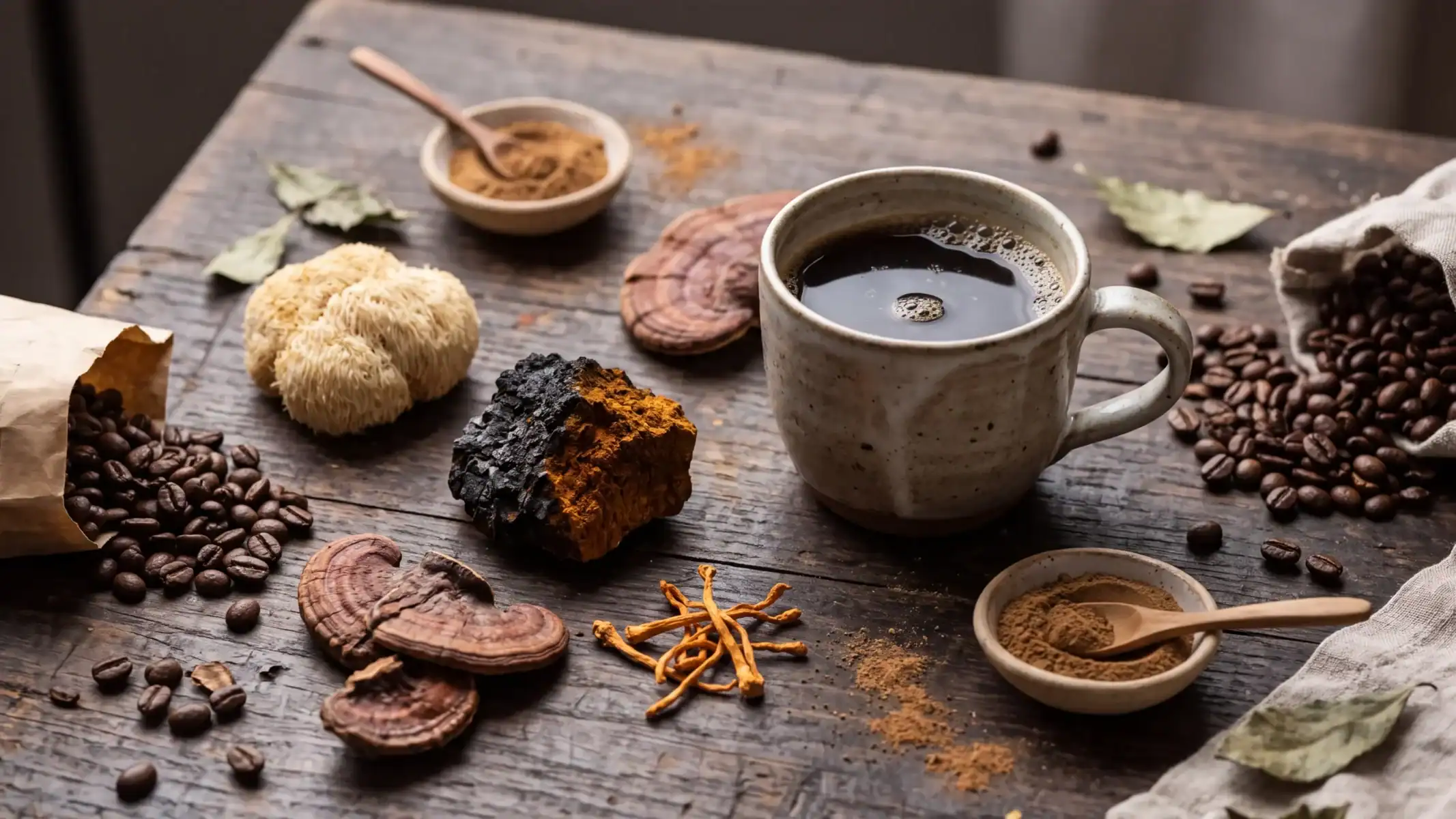
Lion’s mane, cordyceps, reishi, chaga, and turkey tail are common ingredients in mushroom coffee, each with a distinct research history. Claims about mental clarity or immune support require attention to the exact preparation and amount studied.
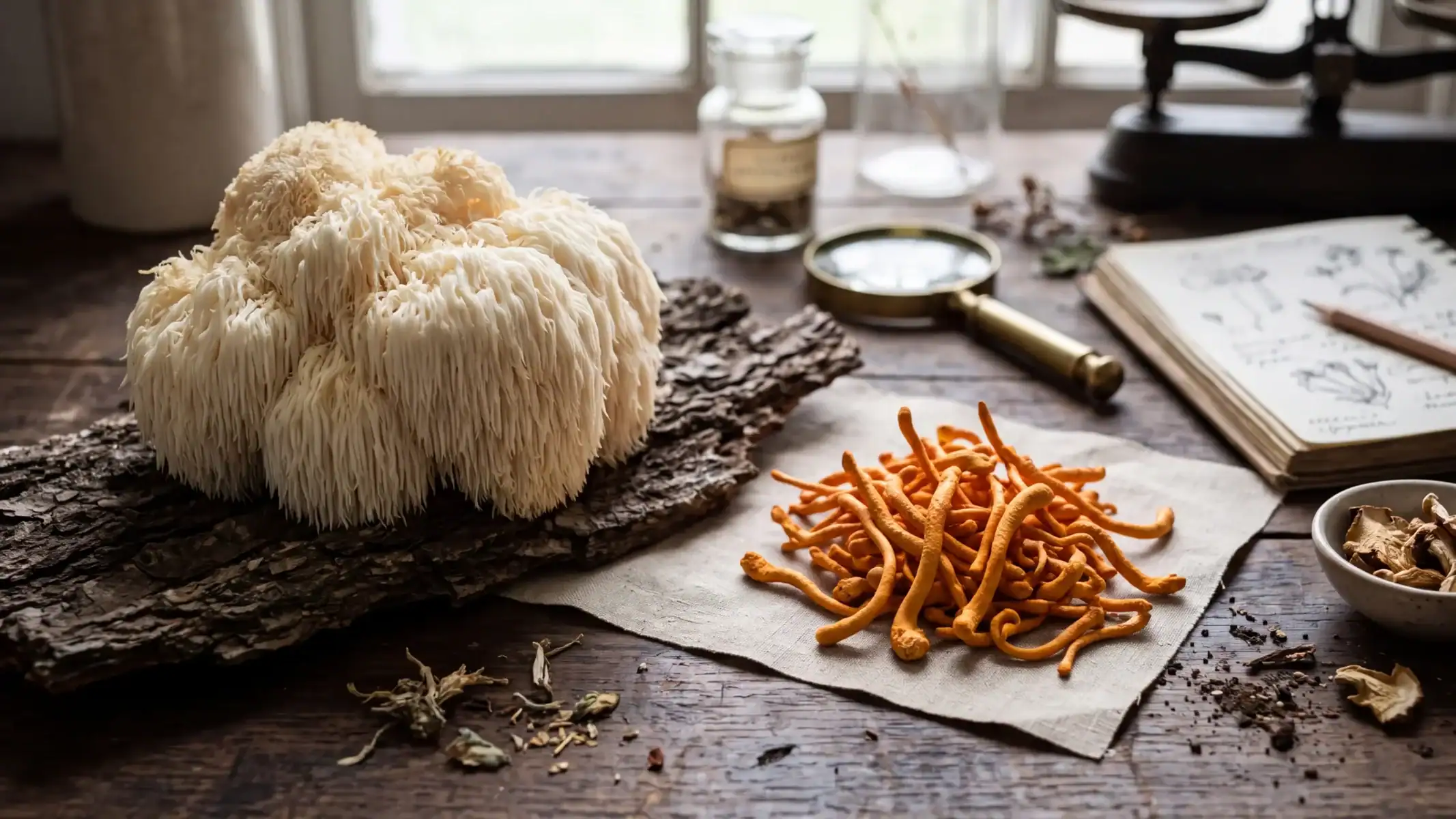
Lion’s mane mushroom (Hericium erinaceus) is studied for cognitive performance and related outcomes. A small human trial in adults with mild cognitive impairment used 3 g per day for 16 weeks and reported improved cognitive scores during supplementation. Those results apply to that preparation and population.
Evidence in healthy adults remains limited, with small trials examining particular cognitive tasks and stress measures. A claim about everyday mental clarity therefore carries more uncertainty than the ingredient’s popularity suggests.
Cordyceps research focuses largely on exercise performance and fatigue-related measures. Human trials have produced mixed results across different preparations and participant groups. Endurance findings also address a different outcome from the immediate alertness produced by caffeine.
Reishi has a long history of traditional use and is marketed for relaxation and immune support. Its clinical literature examines specific extracts and health contexts, while much of the proposed biological activity comes from laboratory work. Describing reishi as an adaptogen does not establish a measurable stress benefit from a coffee serving.
Chaga mushroom is associated with antioxidants because its constituents show antioxidant activity in laboratory models. Human evidence for everyday wellness outcomes remains sparse. Laboratory antioxidant activity alone does not establish a benefit after drinking a chaga-containing beverage.
Turkey tail contains polysaccharides studied for immune-related activity, including specialized preparations used in clinical research. Those preparations differ from an unspecified turkey tail ingredient in coffee. Findings involving medical treatment settings should remain separate from everyday beverage claims.
Research on an individual mushroom establishes evidence for the material and conditions tested. A finished coffee introduces additional variables, including caffeine, other mushroom species, and its preparation method.
A useful comparison checks the mushroom species, tissue, extraction process, serving amount, and duration of use. A dried whole-mushroom dose and an extract dose are different measurements. Without sufficient compositional information, converting between them creates a misleading impression of equivalence.
Product-specific human trials offer the most direct evidence for a finished formula. Ingredient research provides context, while claims about a particular coffee need support that matches that product.
Extract and dose labels describe the mushroom material and the quantity supplied in a serving. Their usefulness increases when the package identifies each species and provides measurable composition details.
The fruiting body is the reproductive structure recognized as a mushroom. Mycelium is the network of fungal threads that grows through a substrate. Both contain biologically active compounds, with profiles that differ by species and cultivation conditions.
Mycelium grown on grain requires particular label attention because the finished material sometimes includes the growth substrate. Wording such as “mycelial biomass” or “cultured on oats” helps identify that preparation. Mycelium grown in liquid culture is a different production format.
Extraction uses a solvent, such as water or alcohol, to draw out selected constituents. Fruiting body extracts identify the starting tissue, while extraction details explain how it was processed. Neither description alone establishes the dose or clinical effect.
Beta-glucans are fungal cell-wall polysaccharides studied for immune-related activity. A declared beta-glucan percentage gives a more specific compositional measurement than a broad “polysaccharides” claim, which also encompasses other carbohydrates.
That percentage still needs a serving amount to become useful. A concentration figure describes the proportion of material measured; the amount consumed depends on how much extract the serving contains. The testing method also affects how the result should be interpreted.
An extract ratio describes the relationship between starting material and finished extract. Its interpretation requires details about the starting material and manufacturing process. A larger ratio alone establishes neither a higher beta-glucan content nor a stronger clinical effect.
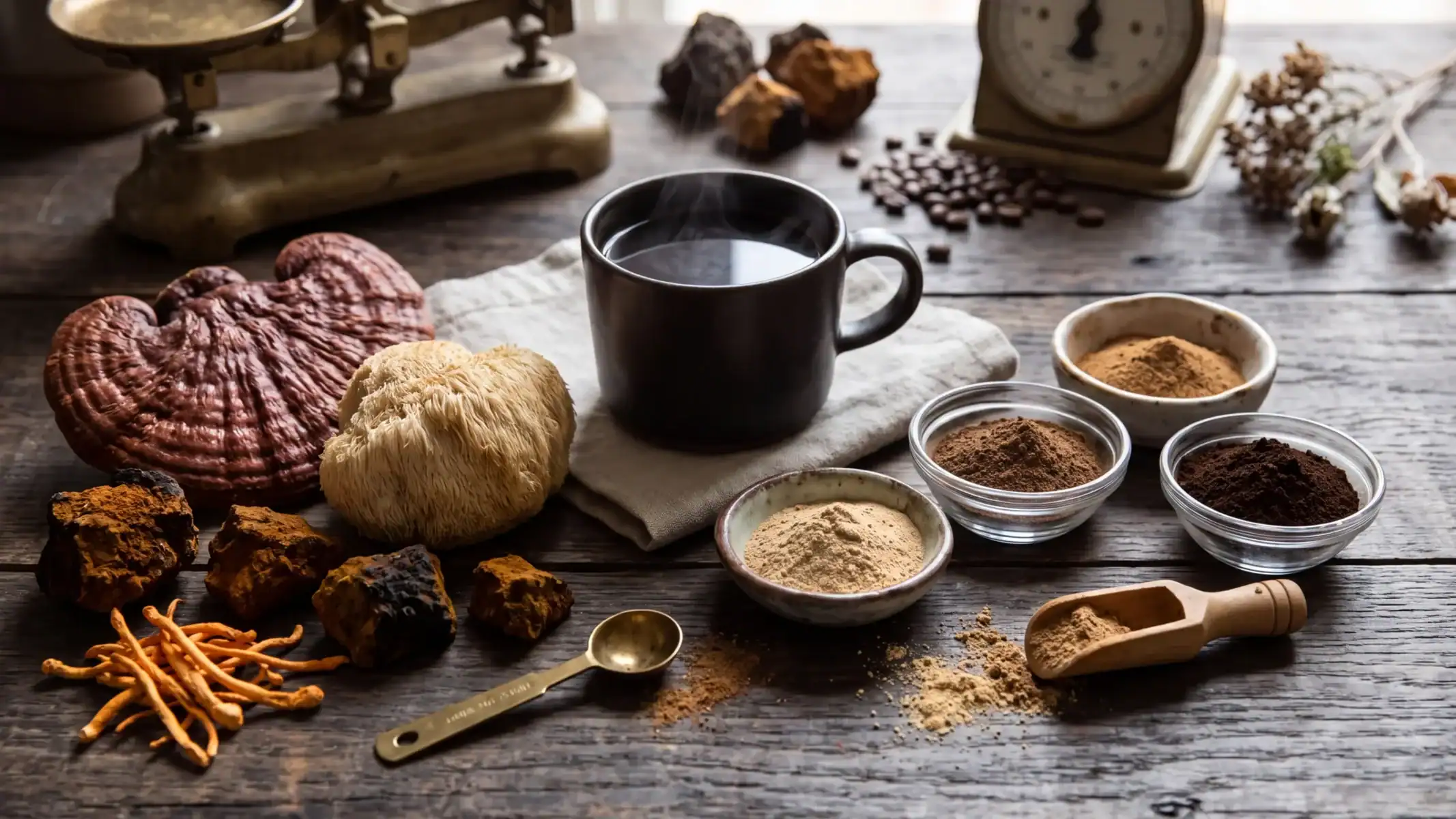
A label that lists a separate amount for every mushroom permits a direct per-ingredient comparison. A combined blend weight reveals the total mushroom ingredient mass, while leaving its distribution among species unresolved.
The most useful label checks include:
A total blend weight should never be divided equally among the listed mushrooms without an explicit statement from the manufacturer. Ingredient names alone provide no basis for assuming equal portions.
Organic claims should identify the ingredient or finished product covered by certification. “Organic coffee” describes the coffee component; “organic fruiting body extracts” describes a separate ingredient claim. Each requires its own appropriate documentation.
Testing claims become useful when they identify what was measured. Relevant checks include species identity, beta-glucan content, heavy metals, and microbial contamination. A batch-specific certificate of analysis connects those results to an identifiable production lot.
Organic certification and contaminant testing answer different questions. Certification addresses production requirements, while laboratory results describe the sample tested. A “third-party tested” statement becomes more informative when the manufacturer supplies the laboratory report and applicable testing limits.
Caffeine content comes from the coffee component and the amount prepared per serving. The presence of functional mushrooms alone provides no reliable caffeine figure.
Adding mushrooms does not remove caffeine from coffee. A lower-caffeine serving requires less caffeinated coffee, a lower-caffeine coffee base, or another formulation change that reduces the final amount.
Some blends contain a smaller coffee portion per serving, which explains their reduced caffeine content. Other blends retain a substantial coffee base. A product’s stated caffeine measurement is more useful than a category-wide average.
“Sustained energy” describes an intended experience, with individual responses influenced by caffeine sensitivity and sleep. Mushroom ingredients do not establish that a beverage will prevent jitters or an afternoon slump.
For instant products, the amount of powder used determines how much of the labeled serving enters the cup. An oversized scoop increases the coffee and mushroom ingredients together. Adding extra water changes concentration while leaving the total caffeine from that scoop unchanged.
Ground blends introduce brewing variables, including the quantity of grounds and extraction conditions. A larger mug also makes “one cup” an imprecise serving description.
A practical caffeine check starts with the manufacturer’s specified serving and preparation directions. Daily intake should also account for tea, energy drinks, supplements, and other caffeinated products.
People who are pregnant or breastfeeding should discuss concentrated mushroom blends with a clinician because safety information for these preparations is limited. The same precaution applies to children and people managing significant medical conditions.
Medication use deserves an ingredient-by-ingredient check, especially with anticoagulants, immunosuppressants, or stimulant medicines. People with mushroom allergies should avoid products containing their allergens. Caffeine-sensitive individuals also need the product’s caffeine information before choosing a serving.
Kidney disease or a history of calcium oxalate stones warrants particular attention to chaga. Kidney injury has been reported after substantial or prolonged chaga consumption. Those reports do not establish the risk of every coffee formula, but they justify a clinician’s assessment of the exact product and intended intake.
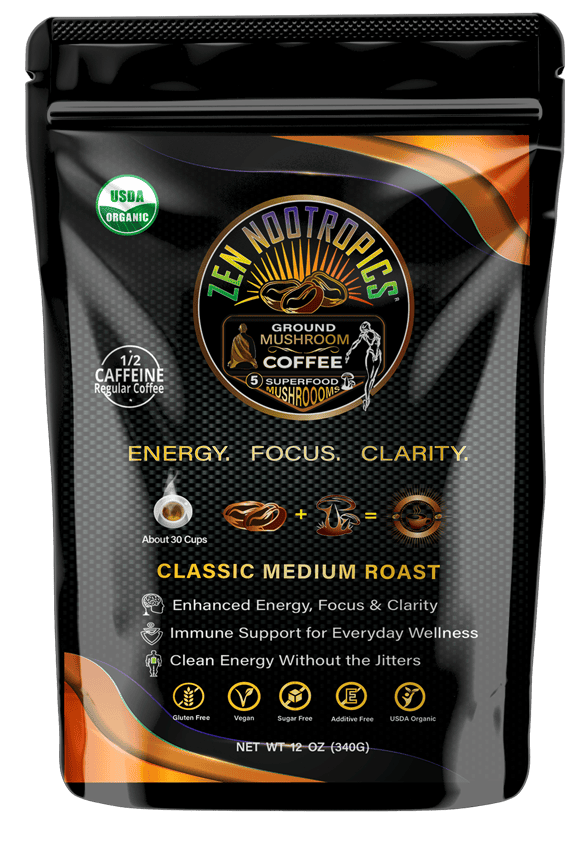
Zen Nootropics’ coffee combines USDA organic Colombian coffee with lion’s mane, cordyceps, reishi, chaga, and turkey tail. It is offered as a pre-ground blend for consumers who prefer brewing coffee with their existing equipment.

The coffee base uses single-source Colombian beans, with fair-trade coffee beans also identified in the brand’s product information. Zen Nootropics’ mushroom coffee combines organic Colombian coffee with five functional mushrooms: lion’s mane, cordyceps, reishi, chaga, and turkey tail.
The brand positions the blend for balanced energy, focus, and immune support. These are wellness claims, and an individual’s experience remains separate from evidence about any single ingredient.
The coffee’s organic designation should be read with its stated scope. Questions about mushroom tissue, extraction details, and ingredient amounts belong with the current product label or the company’s product support team.
Zen Nootropics describes the coffee as bold, complex, and smooth, with tasting notes of dark chocolate and cinnamon. Tasting notes describe sensory characteristics; they do not establish that chocolate or cinnamon has been added as an ingredient.
The pre-ground format keeps grinding out of the preparation routine. Its finished flavor will also reflect brewing strength and any milk or sweetener added after brewing.
A mushroom latte is a serving option made by combining the brewed coffee with milk or a suitable alternative. Any additions change the drink’s nutritional profile, so the packaged coffee and the finished latte should be assessed separately.
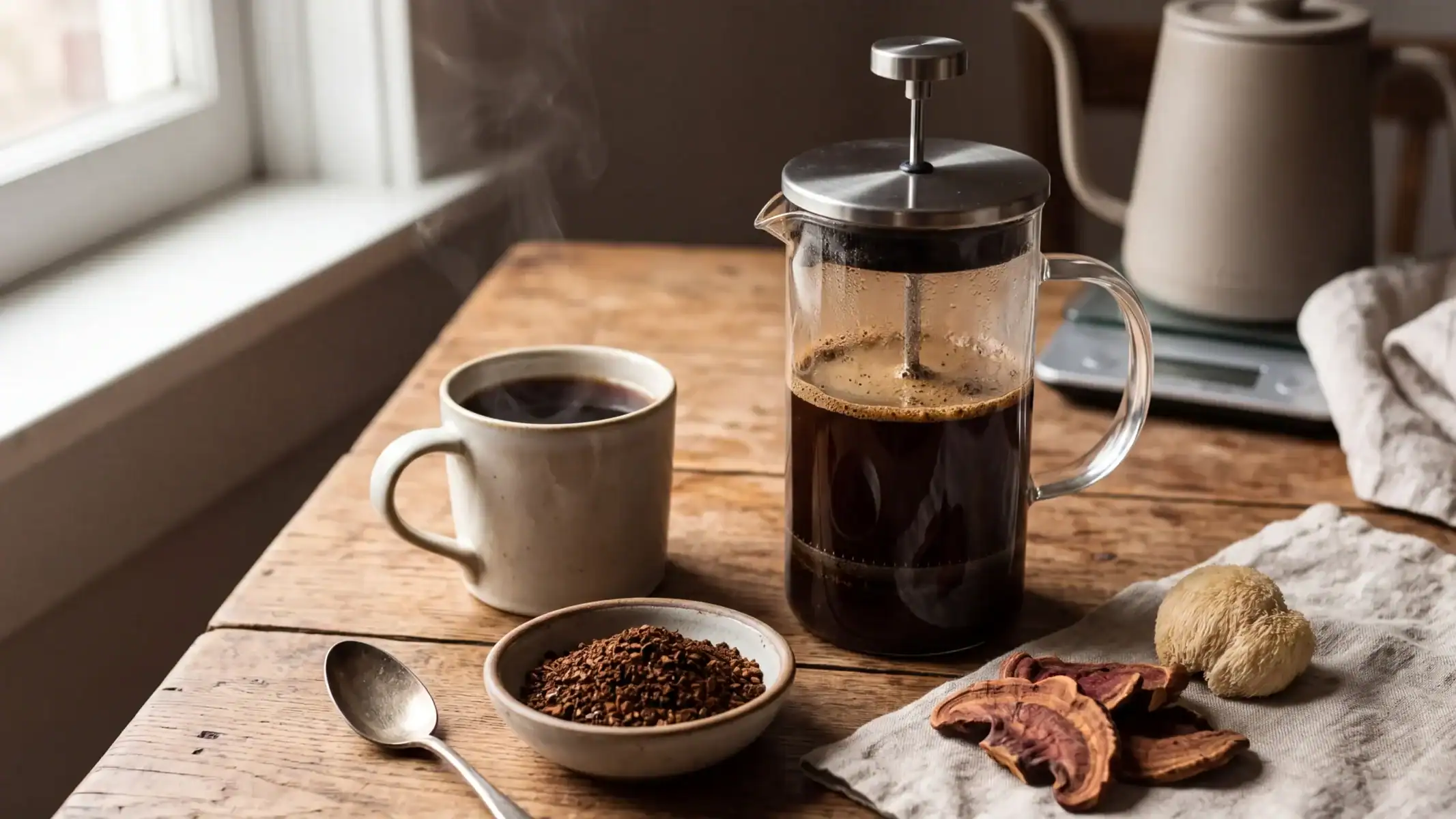
Zen Nootropics states that its grind works with most coffee machines, pour overs, French presses, and some espresso machines. Preparation should begin with the current package directions and the equipment manufacturer’s guidance.
A drip machine or pour-over uses its normal filtration setup, while a French press separates the brewed liquid with its plunger. Espresso compatibility requires closer attention because machines have different grind and flow requirements.
Consistent preparation helps with repeatable flavor. Measuring the dry blend and keeping the water amount steady provides a clearer basis for adjusting strength. For dose questions, the amount placed in the brewer and the amount delivered into the finished drink are separate measurements.
A useful mushroom coffee label identifies the coffee base and explains the functional mushroom ingredients with enough detail to assess the serving. Species names become more informative when paired with tissue identification, extract details, and individual amounts.
For Zen Nootropics, the documented foundation is USDA organic Colombian coffee, five functional mushrooms, and a pre-ground format suited to several familiar brewing methods. Consumers seeking greater ingredient detail should check the current package and request clarification about per-mushroom doses, caffeine, or batch testing before changing their daily routine.
Functional mushroom coffee combines regular coffee with mushroom ingredients such as lion’s mane, cordyceps, reishi, chaga, or turkey tail. Product formulas vary, so review the actual ingredient amounts rather than assuming all blends are equivalent.
Usually, yes, when the blend includes caffeinated coffee. The amount depends on the coffee portion, serving size, and preparation method; mushroom ingredients alone do not determine caffeine content. For general guidance, see the FDA’s caffeine information.
Look for named mushroom species, powder versus extract form, quantities per serving, any standardized constituents, and relevant testing or certification information. A proprietary blend label may not reveal each mushroom’s individual amount.
Research on individual mushroom compounds is not the same as clinical evidence for a finished coffee product. Evaluate claims cautiously and consult a qualified healthcare professional for personal medical concerns.