Does Mushroom Coffee Break a Fast? Rules by Fast Type
A morning coffee ritual fits more easily into fasting when the drink matches the plan...
Read Article →
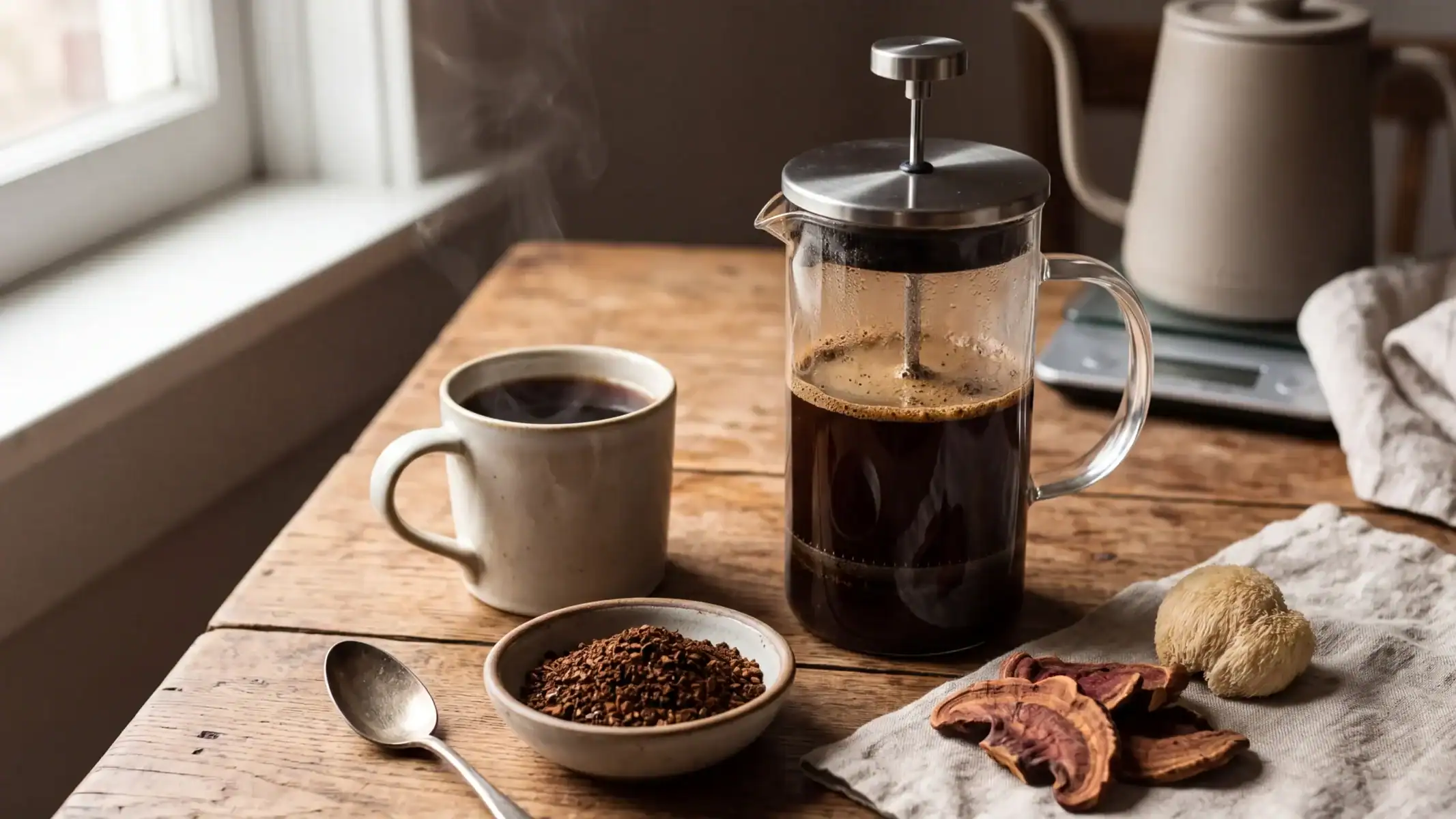
Mushroom coffee in a French press works well with a brewable ground blend: the grounds steep in hot water, the plunger lowers gently, and the finished coffee pours off immediately. This mushroom coffee French press method suits drinkers who prefer a full-bodied cup and control over brewing time. A smooth mushroom coffee French press brew […]
Mushroom coffee in a French press works well with a brewable ground blend: the grounds steep in hot water, the plunger lowers gently, and the finished coffee pours off immediately. This mushroom coffee French press method suits drinkers who prefer a full-bodied cup and control over brewing time.
A smooth mushroom coffee French press brew starts with a compatible grind and the package’s serving instructions. Fine mushroom particles sometimes leave sediment, so careful pouring and a clean mesh filter help keep the last sip pleasant.
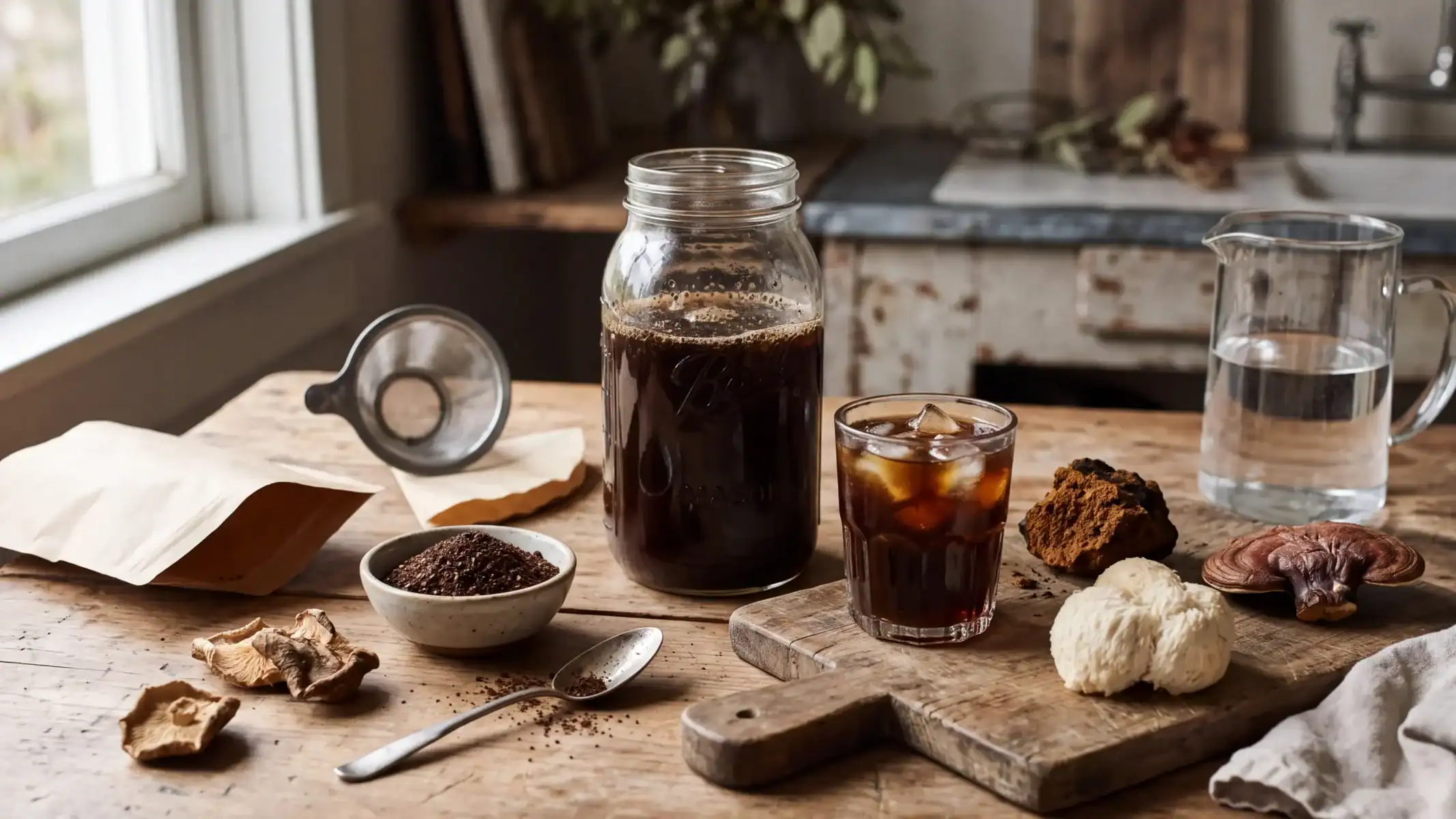
Check the mushroom coffee ingredients and brewing guide if you’re comparing ground blends with instant mixes before choosing a recipe. For a refrigerated immersion method, try the cold brew mushroom coffee recipe. For more ways to serve the finished brew, see our hot, iced, and latte recipes.
A ground coffee blend labeled for French press brewing is the most straightforward choice. A sound mesh filter and a scale help make the preparation repeatable.
Ground mushroom coffee contains coffee grounds that require brewing. Instant mushroom coffee dissolves when mixed with water, while a separate mushroom powder requires preparation according to its own directions.
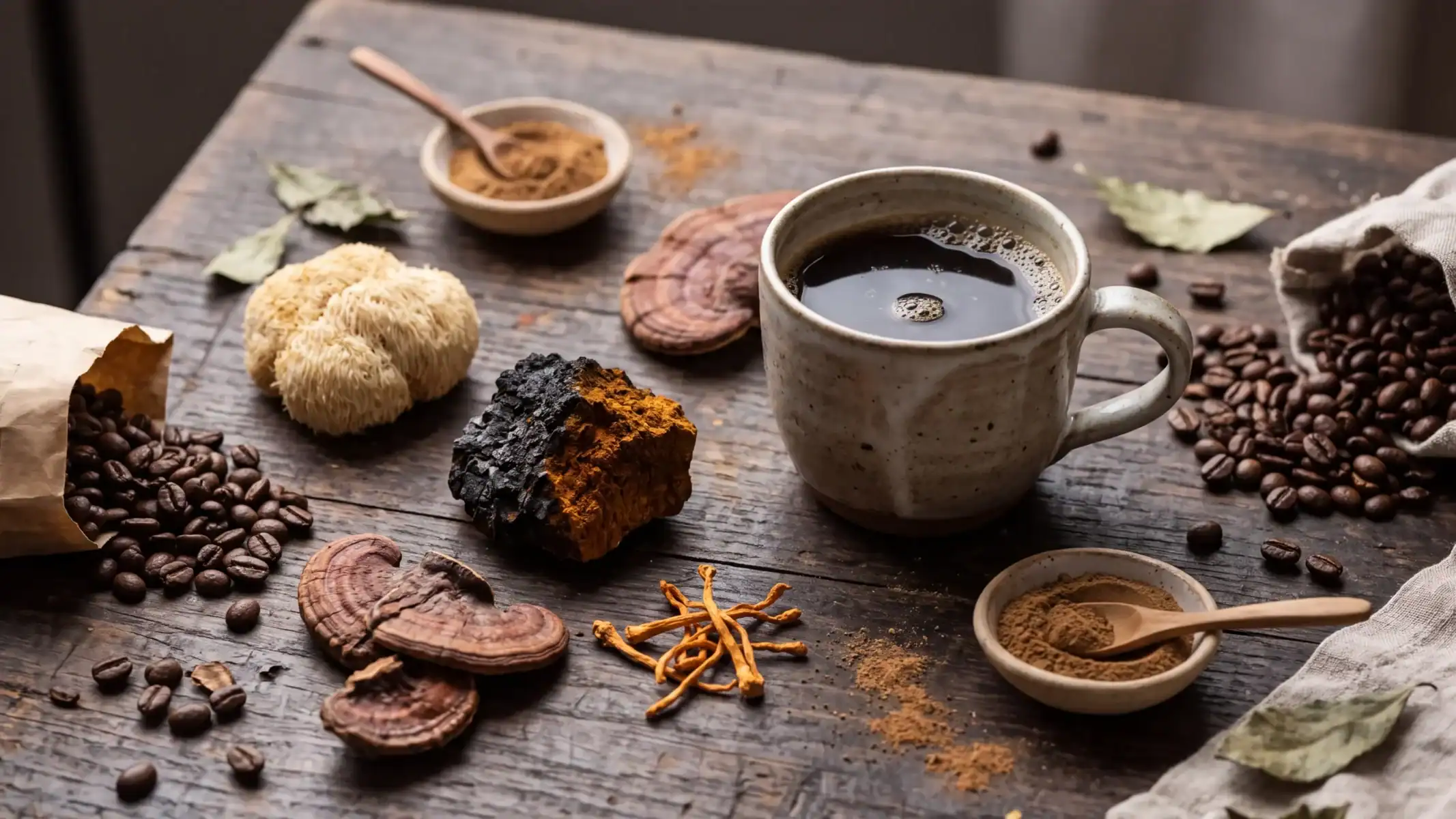
Products featuring lion’s mane, cordyceps, reishi, or chaga come in different formats. The phrase “medicinal mushrooms” alone says little about brewing compatibility; the preparation instructions identify whether the product contains ground coffee, soluble extracts, or other mushroom material.
Zen Nootropics offers pre-ground coffee made with USDA organic Colombian coffee and five functional mushrooms: Lion’s Mane, Cordyceps, Reishi, Chaga, and Turkey Tail. The brand lists French presses among its compatible brewing methods, with preparation guided by the product’s instructions.
A coarse, reasonably even coffee grind suits a conventional French press mesh. Freshly ground coffee offers grind control, while a compatible pre-ground blend provides convenience. Regrinding a prepared blend creates more fine particles and increases the likelihood of grit.
The basic equipment includes:
General preparation across other formats belongs in the mushroom coffee preparation guide. For a French press, grind compatibility and mesh condition deserve particular attention.
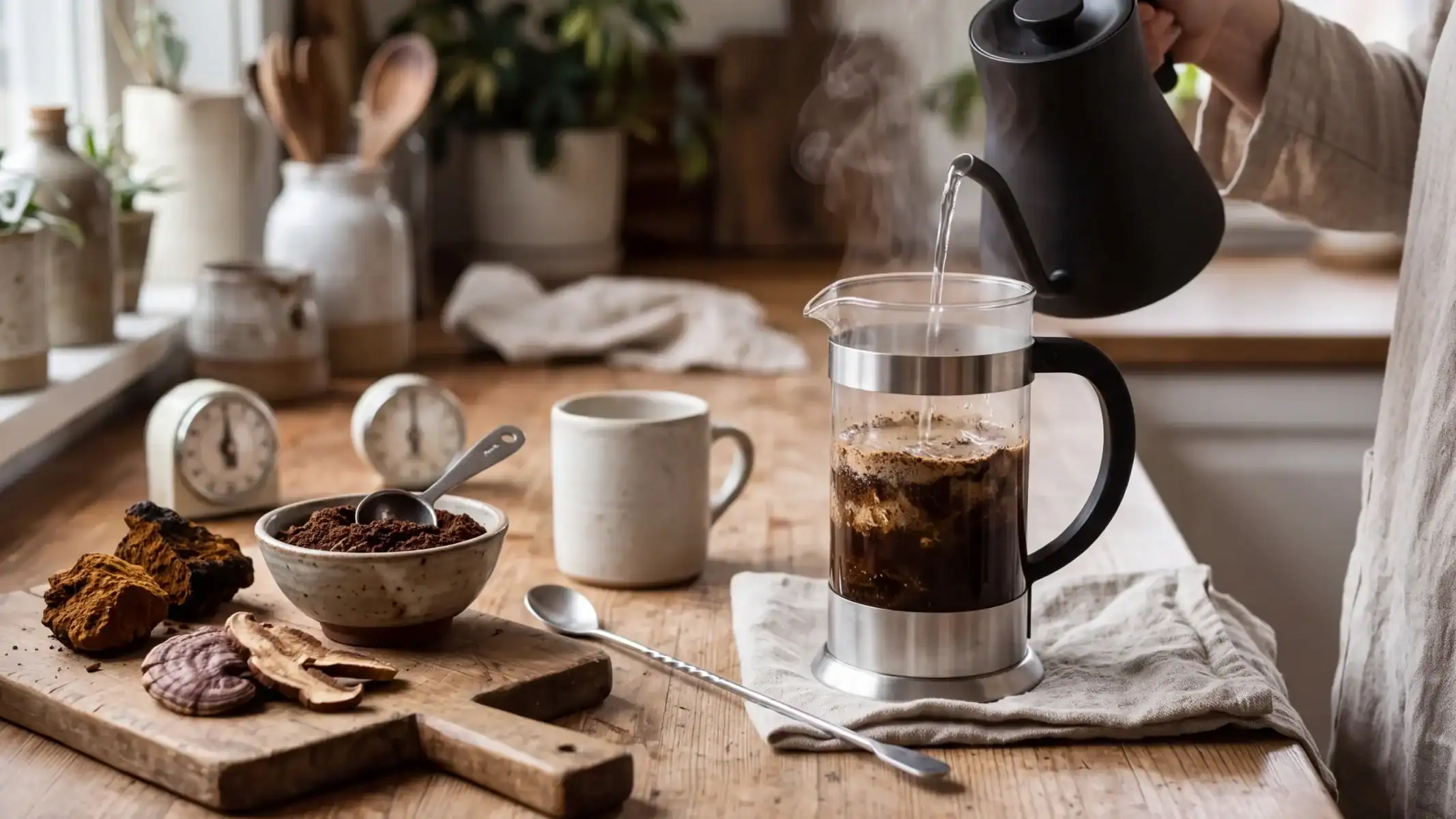
A balanced mushroom coffee French press brew comes from the package’s coffee-to-water ratio, controlled water temperature, and a timed steep. The following sequence keeps French press mushroom coffee preparation consistent without assuming a universal mushroom serving size.
| Brewing stage | Starting approach |
|---|---|
| Measure | Follow the blend’s package quantities |
| Heat | Use 195–205°F water unless directed otherwise |
| Saturate | Wet all grounds and stir gently |
| Steep | Start with 4 minutes if the package gives no time |
| Finish | Plunge slowly and decant immediately |
For a standard ground-coffee reference, the National Coffee Association’s French press brewing guide describes a coarse grind, roughly four minutes of contact, and approximately 93°C water. These are general coffee starting points, not proof of mushroom extraction or a replacement for your blend’s label directions.
Use the package instructions as the starting coffee-to-water ratio for your mushroom coffee French press brew. A mushroom blend’s serving size reflects its formulation, so a conventional coffee recipe should not automatically replace those directions.
The ingredients for each batch are:
Your mushroom coffee French press batch size follows the selected package recipe and must fit safely below the press’s maximum fill level. When instructions specify only a serving amount, the manufacturer’s recommended water volume provides the appropriate starting point.
Preheating reduces heat loss when brewing begins. The carafe receives warm water first, following its manufacturer’s thermal-shock precautions, and that water is discarded before the grounds enter.
This temperature range is a brewing starting point. It carries no guarantee about mushroom extraction or product potency, and the package takes priority.
Complete saturation helps prevent dry pockets from producing uneven extraction. Water should reach the whole bed of grounds, including material near the carafe wall.
Blooming allows trapped gas to escape from coffee. It is optional for immersion brewing and does not “activate” mushroom ingredients. A utensil approved for the carafe avoids damage during stirring.
A 4-minute total steep is a practical starting point when the package supplies no French press timing. Timing begins at the first contact between grounds and water, including any bloom.
The plunger separates most grounds from the poured coffee; it does not isolate every particle from the liquid remaining inside. Decanting the whole batch, as recommended in Sightglass Coffee’s French press brewing guide, prevents continued contact with the grounds and makes the next timing adjustment easier to evaluate.
Sediment calls for filtration and handling adjustments, while bitterness or weak flavor calls for changes to the brewing recipe. Treating those problems separately prevents unnecessary changes to mushroom coffee taste.

A French press mesh retains larger grounds while allowing coffee oils and fine particles into the cup. Powdered mushroom material that remains suspended also passes through when its particles are smaller than the mesh openings.
This gives French press coffee a heavier texture than paper-filtered drip coffee. A light deposit at the bottom of the mug is compatible with normal mesh filtration; large grounds suggest a damaged screen, poor filter fit, or unsuitable grind.
Gentle handling keeps settled particles from becoming suspended again. After steeping, the plunger should move with steady, light pressure, followed by a slow pour that leaves the sludgy final portion behind.
A plunger that resists movement needs attention before further pressure. The press should remain stable while the lid is carefully lifted and the obstruction checked, following the manufacturer’s instructions.
For a cleaner texture, the brewed coffee can pass through a rinsed paper filter in a suitable holder. Paper captures additional suspended material, including some undissolved mushroom particles; its effect on the final mushroom ingredient amount is unquantified.
Bitterness, sourness, and weakness point toward different adjustments. The same blend and water quantities should remain fixed while steeping time or temperature changes.
| Result | First adjustment |
|---|---|
| Bitter or drying | Shorten the steep |
| Sour and thin | Extend the steep |
| Weak but otherwise balanced | Reduce water within package guidance |
| Excessively heavy | Increase water within package guidance |
| Gritty with acceptable flavor | Improve settling and filtration |
Overextraction contributes harshness, while underextraction leaves sour or thin flavors. Roast character and mushroom ingredients also affect taste, so bitterness alone does not prove that steeping ran too long.
Milk and sweeteners are optional finishing ingredients. An initial taste of the plain brew reveals whether the underlying problem is strength, bitterness, or texture.
Milk softens the perception of earthy flavors, and sweetener changes perceived bitterness. Neither removes sediment, so filtration problems need correction before additions disguise the base cup.
The press needs cleaning after each batch to remove trapped grounds and coffee oils. Particular attention belongs on the mesh assembly, where residue collects between its layers.
Spent grounds belong in household waste or a suitable compost system. Keeping them out of plumbing prevents buildup in drains and traps.
Once the press is safe to handle, a soft spatula helps remove the bulk of the grounds. A little water loosens the remainder, which pours through a fine sink strainer for disposal.
After a mushroom coffee French press brew, warm water and mild dish soap remove residue from the carafe, lid, and plunger. A rinse alone leaves oily films behind, particularly around the screen’s edge.
The filter assembly should be disassembled as its manufacturer permits. A soft brush reaches trapped particles between the mesh and support plates; thorough rinsing removes soap before the components air-dry. Bent mesh or an uneven edge warrants inspection before the next brew.

A repeatable mushroom coffee routine uses the same measured recipe and records small adjustments. The useful notes are the blend quantity, water volume, temperature, steeping time, and any filtration change.
Package directions establish the baseline. Gentle plunging and immediate decanting then help preserve the intended brewing time without carrying excess sediment into the mug.
Compare the Zen Nootropics pre-ground coffee blend against their preferred brewing routine.
Mushroom coffee in a French press also raises practical questions about batch size, iced serving, and storage. The product’s preparation directions remain the starting point for each variation.
Instant mushroom coffee dissolves directly in water, so the carafe serves as a mixing vessel. The plunger provides little benefit for a fully soluble product, and any remaining solids should be handled according to the package instructions.
A large French press accommodates one serving when the grounds remain fully submerged and the brewer’s minimum-fill guidance permits it. Preheating is especially helpful for a small batch because the larger carafe absorbs heat from the brewing water.
Hot-brewed mushroom coffee works as an iced drink after decanting and cooling. Melting ice dilutes it, while cold brew mushroom coffee uses a separate cold-steeping preparation that requires its own package-compatible recipe.
French pressing provides no dependable caffeine reduction. Caffeine intake reflects the blend’s caffeine content, the amount brewed, and the portion consumed.
French pressing provides no established increase in mushroom-extract potency. A longer steep changes coffee extraction and flavor; the product’s stated serving directions remain the reference for its mushroom ingredients.
Leftover brewed mushroom coffee belongs in a clean, covered container in the refrigerator after prompt cooling. The grounds should be removed before storage, and milk or creamer is best added when the coffee is served.