Does Mushroom Coffee Break a Fast? Rules by Fast Type
A morning coffee ritual fits more easily into fasting when the drink matches the plan...
Read Article →
How long does mushroom coffee take to work? You may feel mushroom coffee’s caffeine lift within 15–45 minutes, but there is no established universal onset time for its mushroom components. If you want better energy and alertness or clearer thinking, separating these effects helps you judge what your cup is doing. Your first noticeable change […]
How long does mushroom coffee take to work? You may feel mushroom coffee’s caffeine lift within 15–45 minutes, but there is no established universal onset time for its mushroom components. If you want better energy and alertness or clearer thinking, separating these effects helps you judge what your cup is doing.

Your first noticeable change will likely come from caffeine. Possible changes in mental clarity linked to functional mushrooms have a less certain timeline, and results from mushroom supplements do not automatically carry over to a brewed drink.
You can still assess whether mushroom coffee fits your morning routine. Start with the product’s serving instructions, keep track of how you feel, and give equal attention to your sleep and digestive comfort.
The mushroom coffee ingredients guide explains how blends differ before you compare their caffeine content and serving sizes.

You may notice the caffeine lift during the first hour after drinking mushroom coffee. Your serving size and caffeine sensitivity influence how strong that lift feels.
You feel caffeine as it reaches your bloodstream and blocks some of your brain’s adenosine receptors. Adenosine helps signal sleepiness; caffeine temporarily reduces that signal through a process called adenosine receptor blockade.
That explains why you feel more awake soon after a caffeinated cup. A quick change in alertness gives you little information about the mushroom ingredients, because caffeine already produces that effect on its own.
You can expect caffeine levels to approach their peak around 30–60 minutes after drinking it, although food and individual metabolism affect timing. Your sense of stimulation might fade while caffeine remains in your body.
With a caffeine half-life of about five hours, roughly half a dose remains after that period. Your clearance rate changes with factors such as pregnancy, certain medicines, and smoking. Keep your coffee early in the day if you notice difficulty falling asleep.

You cannot assign a proven onset time to the mushroom components in mushroom coffee. You also cannot turn a supplement trial’s length into a countdown for feeling benefits from your cup.
You have a clearer timing guide for caffeine than for functional mushrooms. Your expectations should reflect the different strength of evidence behind each ingredient.
| What you are assessing | Caffeine | Mushroom components |
|---|---|---|
| First noticeable effect | Possible lift within 15–45 minutes | No established universal onset |
| What you might notice | Greater alertness | No reliable immediate sensation |
| Research format | Caffeine and caffeinated drinks | Specific powders or mushroom extracts |
| Longer use | Tolerance and sleep effects | Outcomes depend on the preparation studied |
| What your cup tells you | Your response to its caffeine dose | Limited insight into mushroom-specific effects |
Your experience of “working” also needs a clear definition. Feeling awake, completing a task with fewer distractions, and changing a lab marker are separate outcomes.
You should read a trial lasting several weeks as a testing period. It does not establish when an effect began unless the researchers measured that question at suitable intervals.
For example, improved cognitive scores after a 16-week lion’s mane trial do not establish a 16-week waiting period for your coffee. You would need measurements during the trial, a comparable product, and similar participants to make a useful timing comparison.
Your drink delivers a specific recipe, while a mushroom extract trial tests a defined preparation. Human research on finished mushroom coffee remains limited, and much of the evidence on medicinal mushrooms comes from laboratory or animal work.
To apply an extract result to your cup, you would need matching amounts and extract specifications. Differences in brewing and serving size add further uncertainty. Promises of cognitive enhancement or other mushroom coffee benefits need evidence on the finished drink.
When asking how long does mushroom coffee take to work, distinguish the well-studied effects of caffeine from claims about specific mushroom species. Research on extracts does not establish a reliable onset time for a brewed blend.
Your blend’s species changes which research is relevant, but it does not provide a reliable countdown to benefits. You should assess claims about focus separately from claims about exercise performance or immune modulation.
You will see lion’s mane marketed for cognitive support because of early human findings and research on nerve-related pathways. Some small trials have reported changes in cognitive test scores, but the results do not establish predictable improvements for every user.
You may also encounter the terms hericenones and erinacines. These compounds are associated with lion’s mane fruiting bodies and mycelium, respectively, and have drawn interest in preclinical research. Their presence in research does not tell you how much reaches your cup or when you would feel a change.
You should view cordyceps research mainly through the lens of exercise outcomes. Work involving Cordyceps militaris has explored exercise tolerance and oxygen use, with mixed findings across preparations and participants. That gives you limited guidance about everyday mental energy.
With reishi, also called Ganoderma lucidum, you will encounter claims about stress and relaxation. Terms such as “adaptogens” and “adaptogenic effects” describe proposed support for handling stress, but they do not establish an onset time. You should still account for the caffeine in a reishi-containing coffee when planning your evening routine.
You do not have a reliable physical sensation that measures antioxidant activity or immune modulation. Feeling energetic after a cup therefore tells you little about chaga or turkey tail.
You will find much of chaga’s health research in laboratory and animal settings. Turkey tail research also includes specialized extracts used in clinical settings that differ from coffee blends. You should avoid using fewer sick days or changes in digestion as proof that these medicinal mushrooms are producing a specific effect.
The answer to how long does mushroom coffee take to work depends partly on the caffeine dose, brewing method, and your individual response. Labels cannot provide a proven onset time for mushroom-derived benefits.
Your label gives you the best starting point for assessing what you are drinking. Clear ingredient amounts and preparation details help you compare a product with the research behind its claims.
You should look for the amount of each mushroom per serving, along with the total blend amount. A combined weight leaves you unable to tell how much lion’s mane or reishi you receive.
Check whether the label identifies a powder or mushroom extract and describes the extraction method. An extract ratio alone does not establish a tested dose or clinical benefit. If a detail affects your purchase decision, ask the company for clarification.
You will see fruiting body extracts made from the visible mushroom and mycelium products made from its thread-like growth network. Mycelium grown on grain can include remaining grain material, depending on how the product is processed. Neither term alone establishes effectiveness.
A fruiting-body extract label helps identify the starting material, while beta-glucan testing gives you more specific composition information. “Polysaccharides” is a broader category that also includes starch. You still need species and extraction details to interpret the bioactive compounds in a product.
Your brewing method and amount of grounds affect the strength of your drink. Food can slow caffeine absorption, while poor sleep changes how much stimulation you feel you need.
If you use caffeine regularly, tolerance may make your usual serving feel less noticeable. If your new blend supplies less caffeine than your old coffee, withdrawal can also cloud your comparison. Keep your preparation steady while you assess the change.
Rather than assuming how long does mushroom coffee take to work is the same for everyone, record your caffeine-related alertness and other observations consistently. A personal log is useful for preferences, not proof of mushroom-specific effects.
You get a more useful picture by tracking specific outcomes under similar conditions. Daily use makes your observations easier to compare, but it does not guarantee mushroom-related benefits.
You should choose a few practical measures before starting. Record how alert you feel after your cup, how easily you stay on a task, whether your stomach feels comfortable, and how you sleep that night.
Use the same questions each day. Note unusual stress or a poor night’s sleep so you do not credit every good day to mushroom coffee. A personal log helps you make a purchasing decision, though it cannot prove which ingredient caused a change.
You should follow the labeled serving and use the same brewing method during your comparison. Keep other caffeine sources steady, including tea and energy drinks.
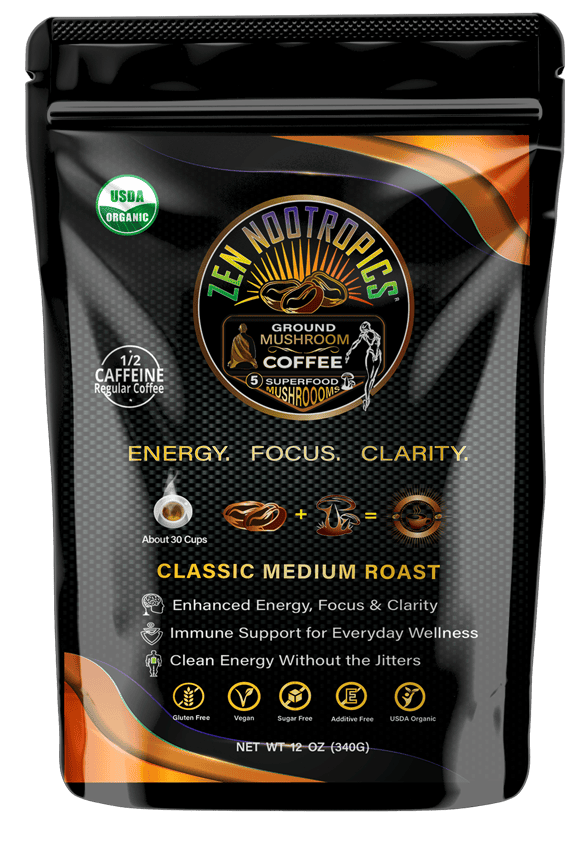
If you want to try a familiar brewed format, Zen Nootropics Mushroom Coffee combines USDA organic Colombian coffee with Lion’s Mane, Cordyceps, Reishi, Chaga, and Turkey Tail. You get pre-ground coffee suited to most coffee machines, pour overs, French presses, and some espresso machines. Review the current label and preparation directions before choosing your serving.
You should decide in advance when you will review your notes. Judge whether you enjoy the drink and whether your alertness, mental clarity, or comfort has changed enough to justify continuing.
There is no evidence-based trial period that guarantees results from mushroom coffee. If you notice no useful difference, you do not need to keep buying it. Stay within label directions, and avoid adding servings or stacking mushroom supplements to force a noticeable effect.
Safety matters more than finding a faster answer to how long does mushroom coffee take to work. Do not increase servings to chase a particular sensation, especially if you are sensitive to caffeine or take medication.
You should assess mushroom coffee side effects from both its caffeine and mushroom ingredients. A wellness label does not remove the need to check your personal risks or medication interactions.
You might experience anxiety, a racing heartbeat, or disrupted sleep if your serving exceeds your caffeine tolerance. Do not assume every mushroom coffee contains less caffeine than your current drink.
Your mushroom ingredients also deserve attention. Reported reactions include bloating, nausea, diarrhea, and allergic reactions. With caffeine sensitivity or a sensitive stomach, monitor your response closely and avoid increasing the serving while symptoms continue.
You should ask a clinician or pharmacist before starting if you take prescription medicines, especially blood thinners, immunosuppressants, or diabetes medicines. Bring the complete ingredient label so they can assess the specific mushroom extracts.
Get advice first if you are pregnant or breastfeeding, have an autoimmune condition, or have kidney or liver disease. Chaga deserves particular caution with kidney problems because of its oxalate content. Discuss the product before scheduled surgery as well, since some mushroom ingredients raise concerns about blood clotting.
You should stop using the product and seek medical advice if you develop persistent digestive distress, unusual bleeding, or a racing heartbeat. Seek emergency care for trouble breathing, throat swelling, fainting, or chest pain.
You should also seek prompt care for yellowing skin or eyes, dark urine, or severe abdominal pain. Acute liver injury has been reported after mushroom coffee use, although a case report cannot establish how common that risk is. Keep the packaging available to show your healthcare professional.
You can judge the first-cup caffeine lift on a short timescale, while mushroom-specific outcomes require more cautious expectations. Functional mushrooms have no established universal onset time in coffee, and daily use does not guarantee a noticeable effect.
Use the labeled serving, prepare your drink consistently, and watch for changes in sleep or digestive comfort. If you enjoy the coffee and it fits your routine, you have a practical reason to continue. If symptoms develop or your main concern is persistent fatigue or declining focus, seek clinical advice.
For more context, read our mushroom coffee caffeine guide, caffeine content and serving-size comparison, and Lion’s Mane research overview. You can also review our mushroom coffee product and brewing information before choosing a serving.
You can use these answers to set practical expectations for daily use and common mushroom coffee effects.
You may notice greater alertness after your first caffeinated cup. That response does not establish that the mushroom ingredients have improved your cognition or stress response.
With daily use, you repeatedly receive the product’s caffeine and mushroom ingredients, and you might develop caffeine tolerance or side effects. Mushroom coffee benefits beyond caffeine remain uncertain for finished blends, so follow the serving directions and track your response.
You do not have a proven minimum trial period to follow. Set a review point that suits your budget, and stop if the drink offers no useful change or causes discomfort.
You cannot rely on mushroom coffee for a proven inflammation-treatment timeline. Laboratory findings about mushroom compounds do not establish that your drink treats inflammation; persistent pain or swelling deserves medical assessment.
You might feel an urge to have a bowel movement soon after drinking it because coffee stimulates bowel activity in some people. That response does not show that the mushroom ingredients are working, and persistent diarrhea or pain is a reason to stop and seek advice.